
If you're running Customer Success (CS) at a B2B SaaS, you're probably being asked to deliver retention, expansion, and happy customers without the people, tooling, or budget that most "best practice" advice quietly assumes.
Most advice is written for companies that already have dashboards being built for them and programs being run on their behalf. But when you're under a hundred employees, somewhere between Seed and Series A, that's simply not your reality...yet.
This guide is built for how you're actually operating today, and what will move the needle right now. You'll get a practical framework you can implement without consultants or a new funding round, including:
- Three core components.
- A sequenced rollout that sidesteps common timing mistakes.
- And metrics that surface risk before it turns into churn.
The aim is to give your team the training, content, and data signals they need to deliver value consistently from day one. By the end, you'll know where to start, what to build first, and how to prove it's working.
What Customer Success Enablement is and why it matters
Customer Success Enablement is the internal function that equips CSMs with the training, content, processes, and account-level insight they need to deliver consistent value from onboarding through to renewal. It standardizes how your team spots risk, drives adoption, and identifies expansion opportunities. In practice, it's the connective tissue that keeps your CS function running smoothly.
Without it, every new Customer Success Manager (CSM) invents their own way of working. One checks engagement daily, another waits for quarterly reviews, and a third only reacts when customers complain. Meanwhile, your best playbooks are living in people's heads, which means when they leave, so does the knowledge.
CS enablement fixes this by creating repeatable, documented answers to "What does healthy look like?" and "When should we intervene?", grounded in data rather than gut feel.
How Customer Success Enablement differs from sales and customer enablement
Customer enablement is customer-facing: help centers, academies, and self-serve resources that let users succeed on their own. CS enablement is internal: preparing your team to guide those customers effectively. Same goal, different audience.
Whereas sales enablement is about winning deals – discovery calls, objection handling, getting to signature – CS enablement is about keeping and growing those deals after the ink dries. Sales teams need battle cards and competitive intel; CS teams need onboarding frameworks and signals that point to expansion.
Customer Experience (CX) enablement covers the entire journey across support, success, and product. CS enablement sits inside that broader effort, focused specifically on post-sale value delivery and relationship management. Where CX looks at how everything fits together for the customer, CS is concerned with helping customers realize outcomes, adopt the product, and renew with confidence.
Why early-stage teams need customer success enablement
The upside is immediate: faster CSM ramp time, consistent customer experiences, proactive churn prevention, and a more systematic way to uncover expansion opportunities. When a new CSM is productive in weeks instead of months, you're not burning budget on dead time.
There's another benefit founders often overlook: CSM retention. Clear expectations and structured development reduce turnover at a stage when losing one person can disrupt dozens of accounts. At a 20-person company, that kind of churn risk hurts fast.
Waiting only makes it worse. Bad habits scale quicker than good ones, and fixing them later costs more. Teams that invest in enablement by month six avoid the scramble at month twelve – when playbooks conflict, alignment slips, churn creeps up, and the board starts asking tough questions. Unpicking entrenched behaviors while your customer base grows is the worst possible timing.
Core components of a CS enablement program
A solid program rests on three things: training and onboarding, content and playbooks, and tools that surface the right data at the right moment. Training explains what to do. Content shows how. Tools signal when to act.
Keep it lightweight. A basic onboarding checklist beats none. A short playbook for your most common scenario beats a sprawling library that never ships. A simple alert when power users go quiet beats a complex dashboard that only one person can use.
These pieces align with the five CS operations pillars:
-
Data – product usage, account health signals, and engagement trends that show what's really happening across your customer base.
-
Processes – standardized playbooks, repeatable workflows, and clear escalation paths that remove guesswork from day-to-day execution.
-
People – CSM training, onboarding, and career development that ensure your team can apply good judgment at scale.
-
Systems – the CRM, analytics, communication platforms, and signal-delivery tools that connect insight to action.
-
Strategy – the goals, metrics, and cross-functional alignment that determine what "good" actually looks like.
Training develops your people, content captures your processes, and tools expose the data that matters. Get that foundation right, and everything else becomes easier to scale.
How to build your enablement program
Implementation strategy
Building a CS enablement program works best when you follow a clear sequence. Start with an audit of where the gaps really are – what's working, what's missing, and where CSMs are losing time. Common gaps include messy sales-to-CS handoffs where context gets lost, customers consistently skipping QBRs because invitation timing or format isn't working, or commercial information buried in scattered systems so teams can't see renewal dates without hunting through multiple tools. Set 3–5 goals tied directly to churn reduction or CSM efficiency. Then build playbooks for your three highest-impact scenarios: onboarding, risk mitigation, and expansion conversations.
Align training to customer lifecycle stages instead of dumping everything on people at once. Connect tools that surface the right signals automatically, rather than forcing your team to dig for them.
Test everything with your strongest CSM first. They'll quickly tell you what works in the real world and what only looks good on a slide. Refine based on their feedback, then roll it out more broadly. It's far cheaper to fix problems early than after habits have set in.
Timing matters more than most founders expect. You need to introduce enablement in months 3–6, before workarounds and bad habits become the norm. Wait until month 12, and you're battling muscle memory and entrenched workflows at the same time you're rolling out new systems.
From day one, weight behaviors by value. High-impact actions – like completing integrations or publishing content – should score 7–10 points in your engagement model. Low-impact actions, such as basic logins, should score 1–2. This helps your team focus on accounts showing real adoption rather than surface-level activity.
Training your CSMs effectively
A structured onboarding program shortens ramp time. Week 1 covers product fundamentals, core use cases, and value by segment. Weeks 2–3 focus on shadowing experienced CSMs and reviewing playbooks, connecting concepts to live conversations. Week 4 introduces 5–10 managed accounts with coaching from a senior teammate. From week 5 onward, ownership increases as confidence and competency grow.
Avoid all-day training marathons. Break learning into 15-minute sessions spread over several weeks, with time to practice between topics. This approach better reflects how adults actually build skills.
New hires surface gaps that veterans overlook. When someone asks, "What do I do when a customer says X?" and there's no clear answer documented, that's a useful signal. Capture it and update your playbooks.
Contextual guidance reinforces learning at the moment it matters. A Slack alert when a Power User goes inactive, paired with a link to the re-engagement playbook, teaches through real situations. This is far more effective than expecting perfect recall weeks after training.
Creating your content library
Start with playbooks for three core scenarios: onboarding, risk mitigation when engagement drops, and expansion conversations. These cover most day-to-day work. Don't try to document everything upfront – you won't finish, and you'll delay launch.
Templates should include email frameworks, QBR (Quarterly Business Review) decks, and call scripts with proven talk tracks. "Proven" means validated with real customers and outcomes, not just polished wording. Use concrete examples and fill-in-the-blank sections so CSMs can customize quickly.
Again, be sure to organize content by lifecycle stage – onboarding, adoption, renewal – rather than by document type. When handling a struggling account in adoption, you don't want CSMs hunting through separate folders for emails, slides, and scripts. Everything for that stage should live together.
Remember, products change, competitors evolve, and objections shift, so review content quarterly and assign clear owners, or it will go stale. Outdated playbooks erode trust faster than having none at all.
Selecting the right tools
A solid CS enablement stack rests on four essentials: a CRM for account data, a communication platform for team updates, product analytics for usage data, and an operator-first platform that turns usage into clear, account-level signals CSMs can act on immediately.
The common trap is tools like Amplitude and Mixpanel are excellent at explaining what happened. CSMs, meanwhile, need to know who needs help right now, without writing SQL or building custom dashboards. Manually stitching reports together, juggling spreadsheets, and calculating health scores by hand burns hours every week and quietly costs thousands in lost productivity.
That gap between analyst tools and day-to-day CS work is where a translation layer becomes essential – one that converts raw usage data into actionable account signals. We'll dig into how to address this in the tooling section below.
Optimizing your program for growth
Who owns CS enablement
At its core, CS enablement is about building training programs, creating and maintaining playbooks, stewarding the tech stack, and proving the program works.
In smaller teams (typically under 20 CSMs), this usually sits with one person, often paired with CS Ops. Once you pass 20–30 CSMs, enablement typically becomes a dedicated role focused on training, content, and program effectiveness.
The skills that matter most: clear documentation, experience training adults, comfort with data tools, and hands-on CS ops knowledge. This role owns the infrastructure but works closely with Sales, Product, and Support to keep everything accurate and relevant.
Metrics that prove ROI
To measure CS enablement ROI, split metrics into two buckets: customer outcomes (churn rate, net revenue retention, CSAT) and team effectiveness (CSM ramp time, time saved, playbook adoption).
Three metrics do the heavy lifting. Churn rate shows whether customers stick around. Net Revenue Retention shows whether your existing revenue base is growing or eroding over time. Active user percentage over time shows whether engagement is rising or slipping.
Track engagement trends against these outcomes using value-based weighting for customer behaviors.
Also watch time-to-signal. The gap between a customer action and your team noticing should stay within 24–48 hours. If a Power User drops off or an account hits a key milestone, CSMs need to know while it's still actionable.
Common mistakes that derail programs
Four missteps sink enablement fast:
- Building pristine playbooks before testing them with customers.
- Choosing tools that require analyst-level interpretation.
- Introducing enablement too late.
- And creating content without clear owners to keep it updated.
Seasoned CSMs won't adopt new tools unless they're easier than what they already use. Add extra clicks or another tab, and adoption stalls. The new way has to be the easy way.
Skip metric overload. Track 5–7 core metrics with discipline rather than measuring everything and acting on nothing. Strong programs preview onboarding in late-stage sales calls, surface edge cases in weekly standups, and trigger education automatically when Power Users go quiet.
Preparing for AI and automation trends
Three AI trends are reshaping CS enablement: predictive churn and expansion scoring that flags risk and opportunity early, AI-suggested coaching topics based on top CSM performance, and training that adapts to individual learning styles.
AI isn't replacing CSMs. Empathy, judgment, and relationship-building still belong to humans. AI handles pattern detection and signal automation, freeing teams to focus on conversations that matter.
When evaluating AI tools, prioritize privacy-first architectures that process behavioral data in secure enclaves rather than public large language models. SOC 2 Type II and GDPR compliance should be table stakes.
How Accoil fits into your enablement program
Product analytics tools are great at answering "what happened?"... for analysts at least. Your CSMs are asking different questions: "Who needs help?" and "What should I do next?" The gap between those two is where CS teams lose time, miss churn signals, and burn budget.
Accoil sits neatly between your product analytics stack (Amplitude, Segment, PostHog) and day-to-day workflows (Slack, CRM). It turns raw usage data into weighted engagement scores (0–100), activation tracking, and clear risk and expansion signals. That fixes the visibility problem we've touched on throughout this guide: product teams love their analytics, but CS teams can't get to actionable insight without custom dashboards or querying.
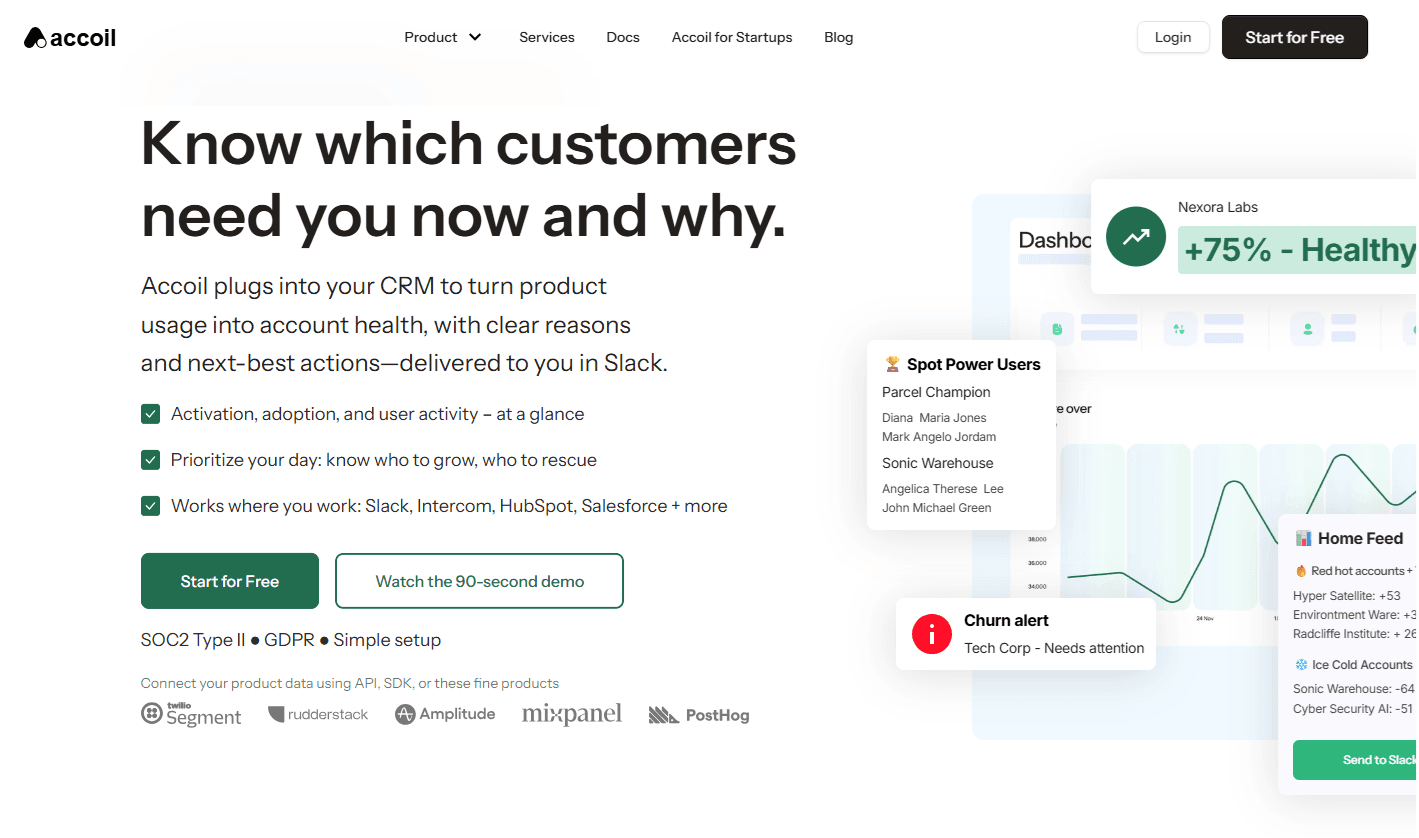
Let's say a customer's engagement score drops because a key feature they were using weekly hasn't been touched, and overall session frequency is trending down. Accoil detects that shift automatically, flags the account as "at risk," and pushes the signal into Slack. At the same time, the updated score and risk status sync back to HubSpot or Salesforce, so the CSM sees exactly what's changed – directly on the account record – without opening an analytics tool or asking an analyst to investigate.
Connecting tools like Amplitude takes minutes to hours, with no engineering or admin lift. Data starts flowing in under 24 hours, meaning value now, not after a multi-month rollout.
Accoil focuses on a rolling 90-day history, keeping insights current and useful for early-stage teams, and is built for B2B SaaS companies with 10–100 employees at Seed to Series A – the exact audience this framework is designed for.
Live segmentation flags accounts moving into risk or expansion automatically, so CSMs know who needs attention today, without manual reviews.
The result is a genuinely operator-first approach to CS enablement: account-level intelligence, delivered in the tools your team already uses, without leaning on analysts to make it usable.
Start implementing your program today
By now, the data visibility gap should be clear: CSMs need usable account signals, not analyst-grade dashboards. When data isn't built for operators, even the best training and playbooks stay stuck in theory because if your team can't see what matters, they can't act on it.
You've got the framework in hand: clear definitions separating CS enablement from adjacent functions, three core building blocks (training, content, and tools), a sequenced rollout plan, and metrics designed to surface risk before it turns into churn. Building CS enablement is a given; the real question is whether you do it now or let bad habits scale first.
Our advice? Don't wait. Book a consultation to audit your current CS data infrastructure and see how operator-first analytics fits into your stack.
FAQs
Do CSMs make good money?
Short answer: yes. CSMs typically earn between $60k and $120k+ in base salary, depending on experience and company stage. Factor in variable compensation tied to retention and expansion, and it's a well-paid role with clear paths into leadership—or sideways into product or ops.
What are the 5 pillars of customer success?
The five operational pillars are data, processes, people, systems, and strategy. CS enablement directly reinforces three of them: processes (via playbooks), people (through training), and data (by delivering the right signals at the right time).